The Research
Each piece of evidence we flagged becomes a thread to pull. Some lead to clean answers. Others open small mysteries of their own.
The "18.75" stamp
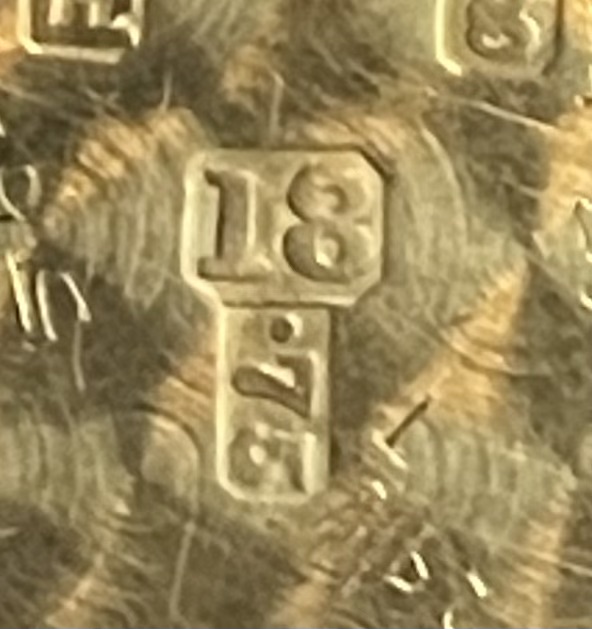
Stamped inside the case is the mark 18.75. This is a continental purity mark: 18-carat gold at 75% purity — in other words, 750‰. It is unambiguous.
To understand why this stamp matters, it helps to know where hallmarking comes from. European hallmarking began in 1275 in France under Philip III, and in 1300 in England under Edward I, whose "leopard's head" mark struck at London's Goldsmiths' Hall gave us the word hallmark. Over the centuries that followed, assay offices across Europe developed a standardised language of tiny stamps: a purity mark (what metal it is), a maker's mark (who is responsible), an office mark (which assay office certified it), and often a date letter (what year it was tested). Every mark on this watch belongs somewhere in that 750-year-old system — which means, if you know how to read them, the case itself is a signed document.
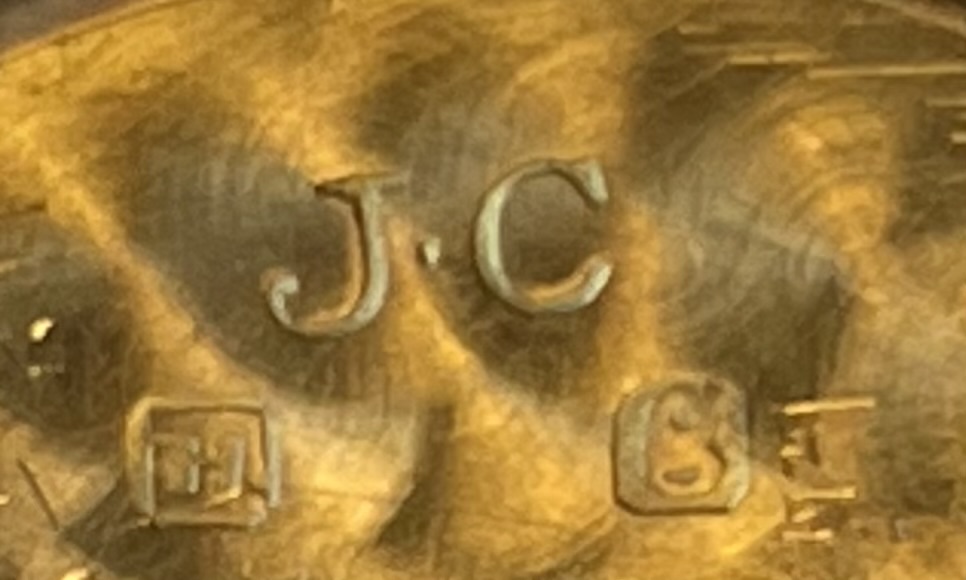
The twin "F" marks
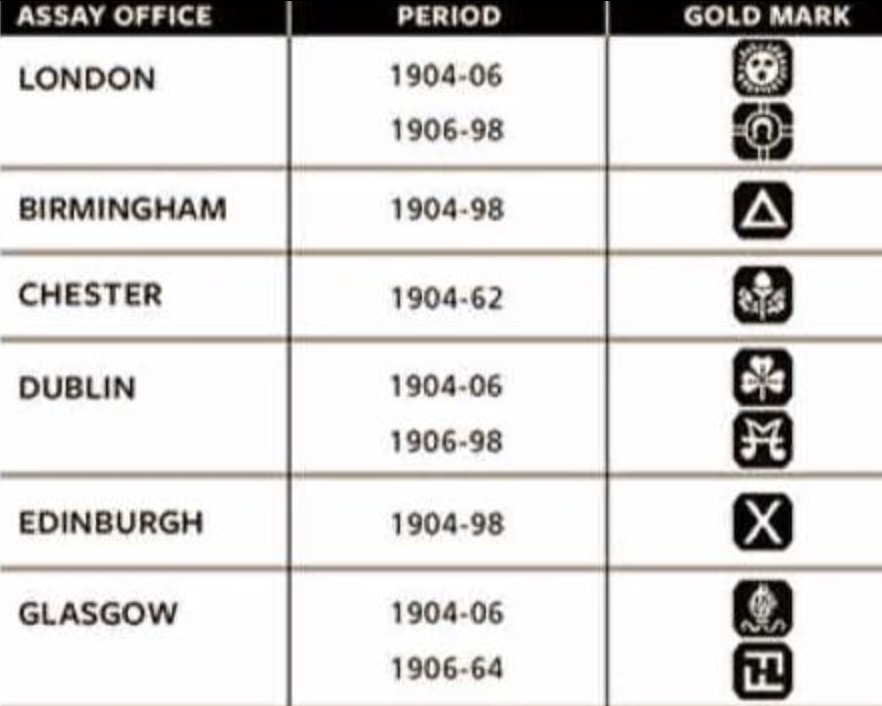
In the position reserved for British import hallmarks sit two stamps showing twin F's — the assay mark of the Glasgow Assay Office. Cross-referencing Glasgow's date letter tables gives us the year the watch was submitted for assay: 1929–1930.
I didn't get this right the first time. Looking at the stamp under magnification, I initially read it as an H and a G — which would have pointed to Henry Griffiths and Sons, a prolific importer of Swiss watches in the 1920s and 30s. It was a clean, plausible answer, and it was wrong. I emailed the London Assay Office to confirm, and they came back with the correction: what I'd read as an H was actually twin F's, the import mark of the Glasgow Assay Office, and the date letter dated the assay window to June 1929 to May 1930. One email rerouted the entire investigation away from a Birmingham importer and into a Scottish assay office.
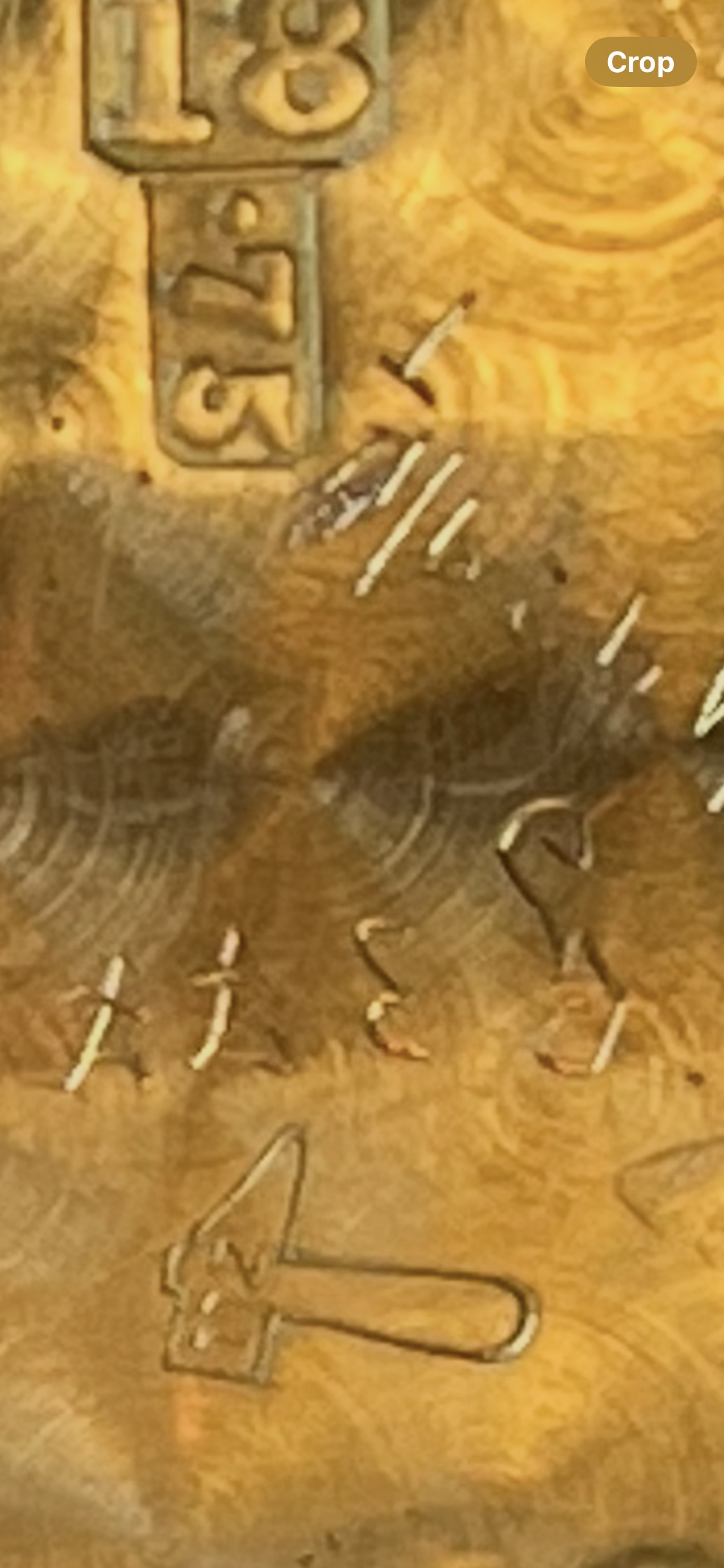
The hammer and "112"
A small stamped hammer containing the number 112 is a French-style poinçon de maître — a master's mark — that traces to Ducommun, a known casemaker. But here we hit a small wall. The surviving registration records for the hammer-only variant of the mark don't extend back to 1929, even though Ducommun is registered with the later hammer stamp.
The hammer-with-handle stamp used to be a genuine identification mystery. Poinçon de Maître No. 2 — the hammer with a handle — was registered in 1926 for non-Geneva gold and platinum cases, but the centralised list compiled in 1934 contained only two names, despite surviving cases being numbered into the 300s. The earlier cantonal records were never transferred to the central register, so for decades nobody could match a hammer-with-handle number to a maker.
The puzzle was eventually cracked sideways. Researchers found a hammer-head mark (PdM No. 1) carrying a number that was already known to belong to C.R. Spillmann SA. The same number then turned up on a hammer-with-handle stamp on a Spillmann-made Rolex case. That single overlap proved the two marks shared one numbering system — meaning the much fuller hammer-head registrant list could now be used to identify the maker behind any hammer-with-handle number. That's how we get from "112" to Ducommun at all.
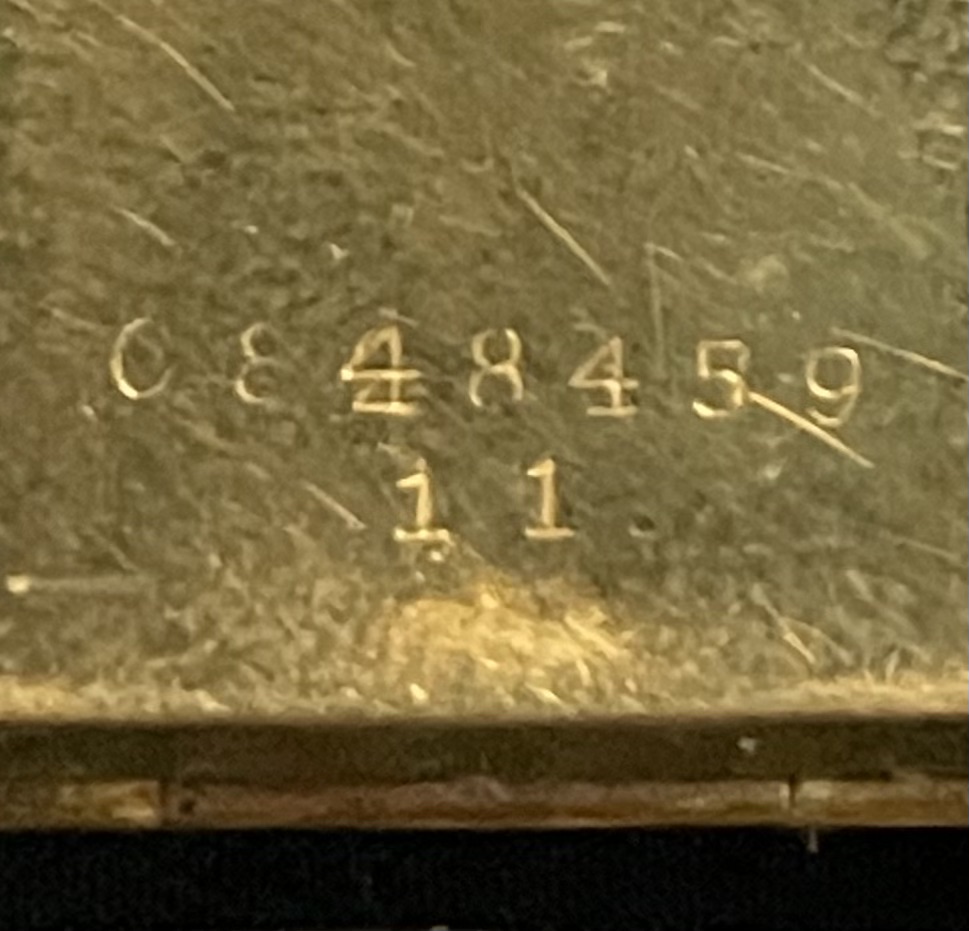
0848459 11
The back of the case carries the serial 0848459 11. It looks definitive, and it isn't. In this period, serial numbers are notoriously unreliable as an identification source — they behave more like patent numbers than modern serials, often recycled or reassigned.
That said, cross-referencing how Cyma and Tavannes structured their case markings in this era suggests a possible reading: 0848459 may be the production sequence number for the watch itself, and the trailing 11 a catalogue or model-type code identifying the variant — case style, calibre family, or reference within Cyma's range. It's a plausible structure for the period, but I haven't been able to turn it into a definitive identification. The internal Cyma references that would map "11" to a specific catalogue entry don't appear to have survived in any source I can access.
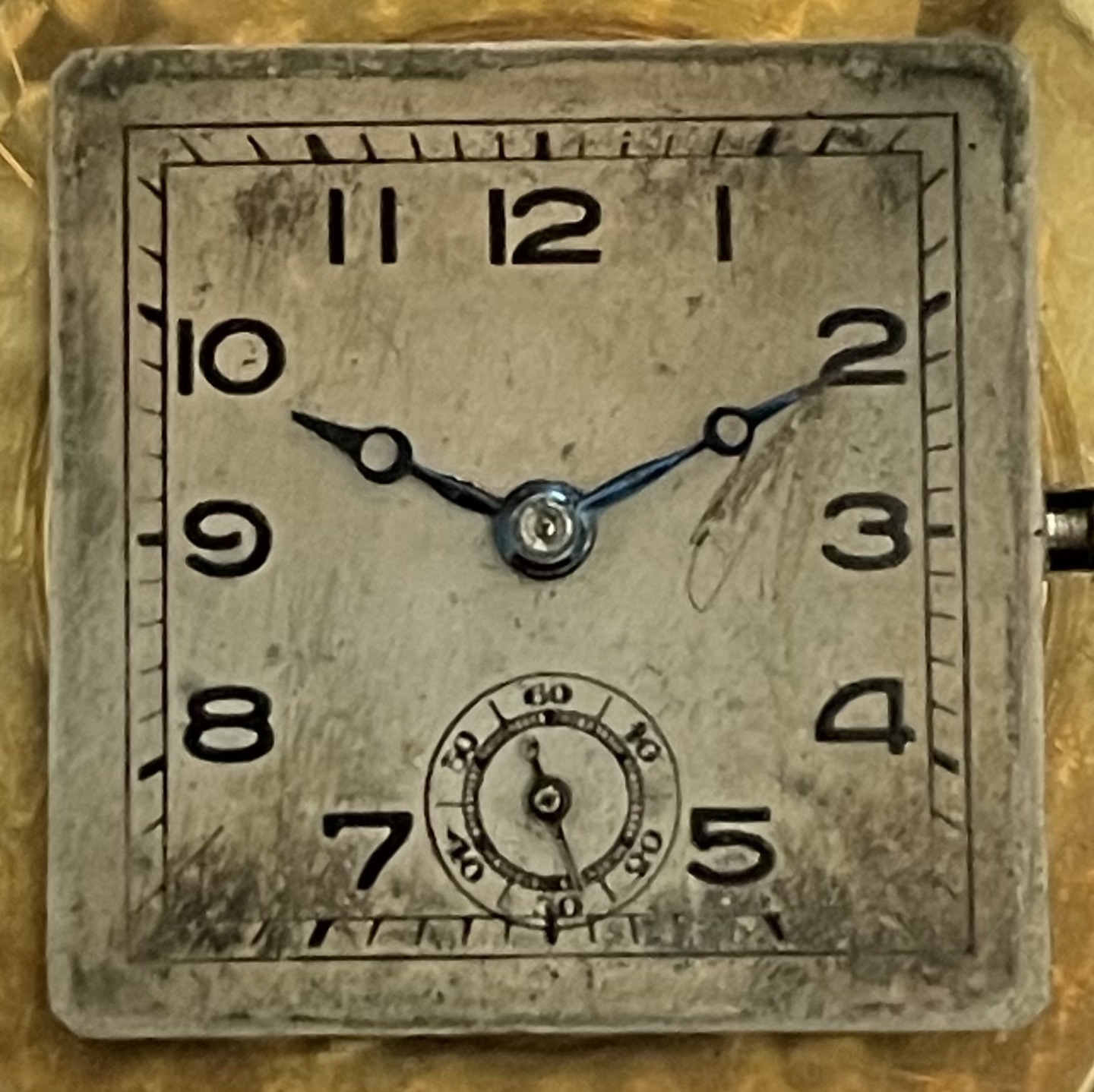
No signature. No brand name.
The dial is blank of any maker's name. This feels wrong to a modern eye, but research into the period tells a different story. In the 1920s, a gold watch was the desired object. The brand was secondary — sometimes deliberately absent — because the metal and the craftsmanship spoke louder than a logo.
There's one detail on the dial that doesn't sit right, though. Look closely at 6 o'clock: the printed railroad track and the sub-second register overlap awkwardly, with the chapter ring crossing into the small seconds dial. For a watch otherwise built with this much care — solid gold, three-adjustment movement, ornate goldwork, blued hands — that level of finishing on the dial face is substandard.
There are two readings:
1. The dial was replaced during a service later in its life, and whoever did the work fitted a cheaper, less precisely printed replacement. This is common on watches of this age — original dials get damaged, owners want them refreshed, and a lower-grade aftermarket dial gets installed.
2. It's the original dial, and the watch was simply produced to a lower standard than the rest of the case suggests. This reading is harder to defend. It contradicts the gold purity, the movement quality, the precision adjustments, the sub-seconds complication, and the ornate casework. Everything else on this watch was built by someone who cared.
I lean toward replacement, but I can't prove it. It remains the most visible loose thread on the watch itself.
Swiss made, three adjustments
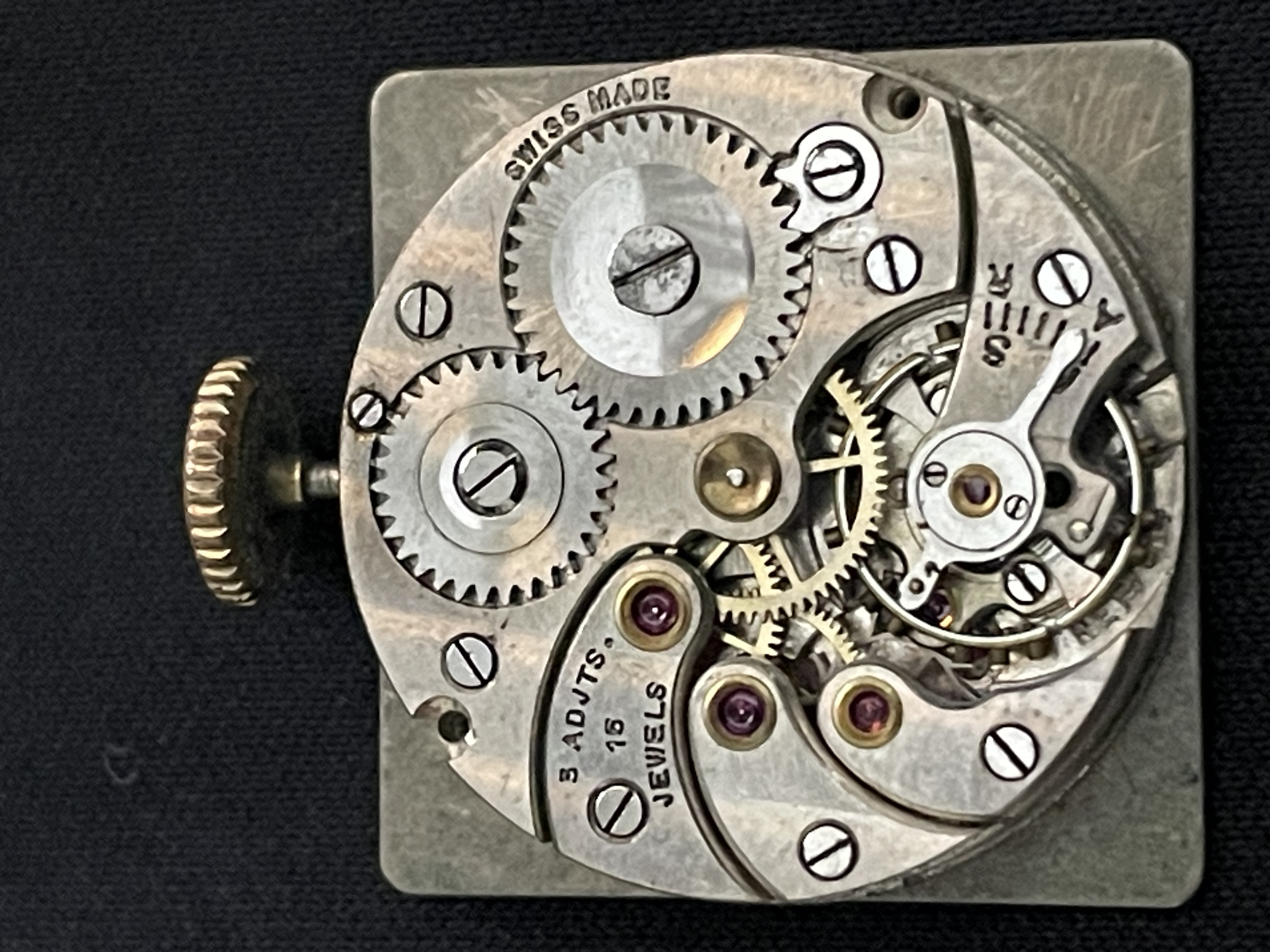
The movement is distinctive in style and marked Swiss Made with three adjustments for precision — a specification that was uncommon in 1929 and a signal of a genuinely high-grade watch.
What "three adjustments" actually means. When a Swiss watchmaker tested a movement for accuracy, they could regulate it in different positions (dial up, dial down, crown down, etc.) and at different temperatures. Each position or temperature the watchmaker tuned the watch to keep accurate time in counted as one "adjustment." A basic movement might be adjusted in a single position. A premium movement might be adjusted in five or six positions plus heat and cold. Three adjustments puts this watch comfortably above the standard production grade — for the original owner, it meant a watch that kept reliable time whether you wore it on the wrist, set it on a dresser face-up overnight, or carried it in a waistcoat pocket. It's a quiet luxury spec, the kind of thing you'd never notice unless you knew where to look.
How we identified the calibre. There's no shortcut here. I trawled through manual-wind movements from the early 1920s and 1930s — Ranfft's database, period catalogue scans, forum threads — comparing each one against my photos. The match comes from getting three things to line up at once: the overall measurements of the movement, the style of the bridges and finishing, and crucially the exact positions of the screws, bridges, and jewels. Eventually one calibre matched all three: the Cyma 12-1 Hunter. You can see the reference here — ranfft.org/caliber/2112-Cyma-12-1-hunter — and the layout matches our movement screw-for-screw.
Why this movement is interesting. The Cyma 12-1 is a manual-wind, but it's an unusually thin manual-wind for its era. That matters because thinness in a movement is what made the smaller, daintier wristwatches of the late 1920s and early 1930s possible at all. Pocket-watch movements were too tall to fit comfortably on a wrist; the move to wristwear required calibres that could be made slim enough to disappear under a sleeve. The 12-1 is one of the calibres that helped that transition happen. So this watch sits at a small inflection point in watchmaking history — pocket-watch DNA, wristwatch ambitions.
A translation for the UK market
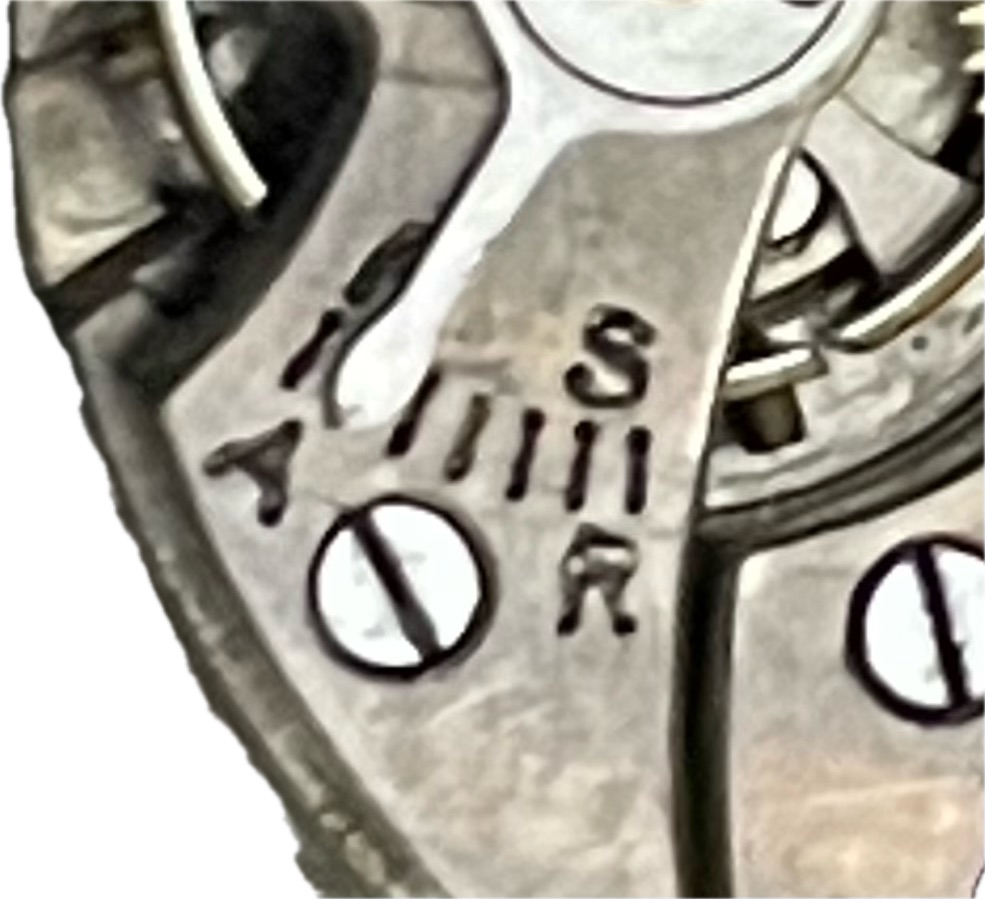
Engraved on the movement: RA SR. These are French watchmaking abbreviations translated for use on Swiss watches imported into the United Kingdom — regulator and second marks repurposed for the English-speaking market.
The sponsor's mark
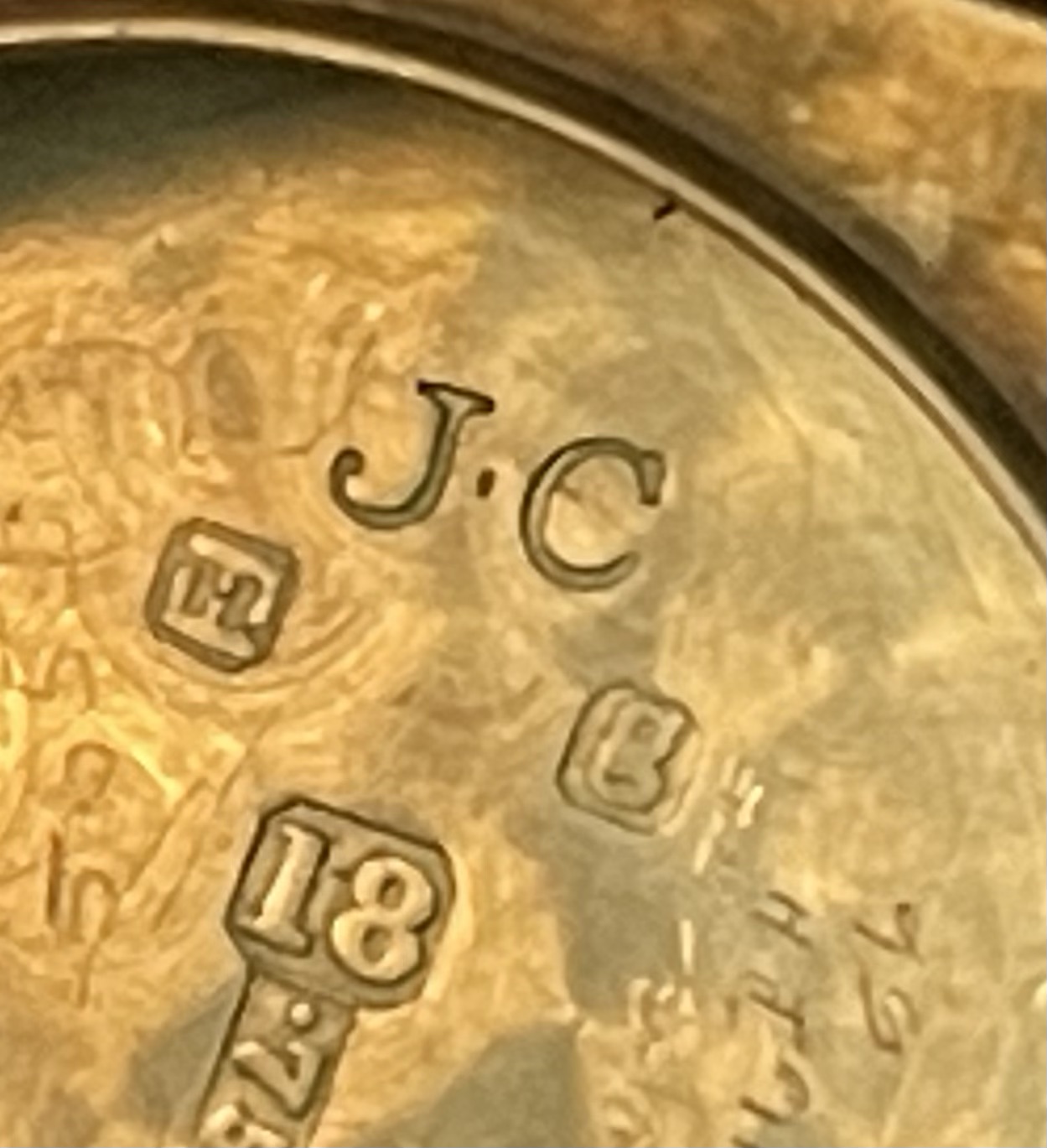
The most important stamp of all sits in the sponsor's position: J·C. In British hallmarking, the sponsor's mark is the legal declaration of responsibility — whoever's initials sit there is guaranteeing to the Crown that the metal is what it claims to be. It is not necessarily the maker; it is the party accountable for the object's provenance.
A search of the Glasgow Assay Office registers returns a swathe of watchmakers and retailers with "J.C" hallmarks around 1929. Which one is ours?
I went through the registered hallmarks for UK importers who stamped gold with JC in this period, looking for one whose registered punch matched the shape, spacing, and proportions of ours. None of the candidates I found match cleanly. To get a sense of how many possibilities there are, look at this list of UK makers' marks beginning with JC: silvercollection.it — JC marks. There are dozens of registered punches across the late 19th and early 20th centuries, and that's only the names that made it into the published registers. The actual sponsor for our watch could be a small importer whose registration record has been lost, misfiled, or never digitised.
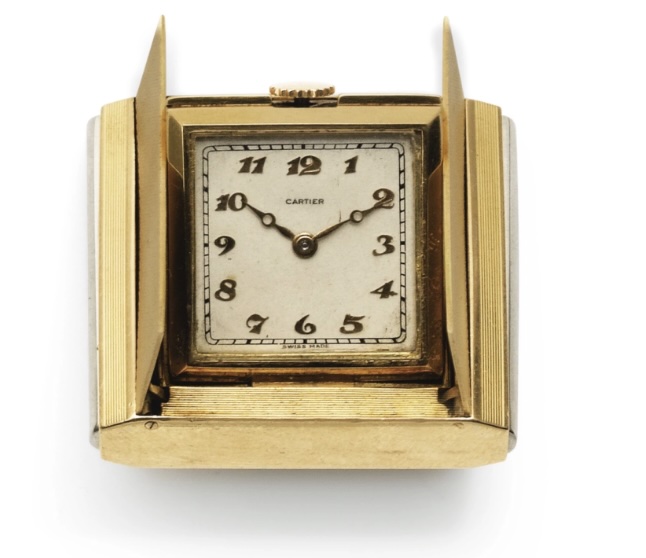
This is the thread that opens the next phase. Because if JC isn't a UK importer we can identify from the registers — and if Sotheby's catalogued their JC stamp on a near-identical 1929 Glasgow gold watch as Jacques Cartier — then the question stops being "which UK importer is this?" and starts being something else entirely.